| Outline |
|---|
♦ Introduction
♦ Related Work
♦ Our Approach
♦ Performance Evaluation
♦ Conclusion
| MANET and Sensor Network |
|---|
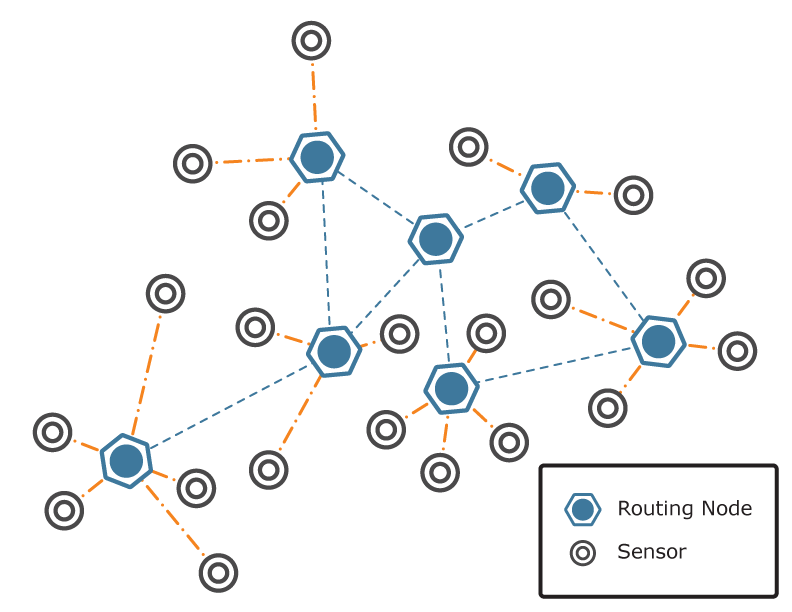
| MANET | Sensor Network (A Special MANET)
| A group of mobile computing devices that are equipped with
WLAN capability.
| WSN is a wireless network consisting
of spatially
distributed autonomous devices using sensors to cooperatively
monitor physical or environmental conditions
at different locations.
| | 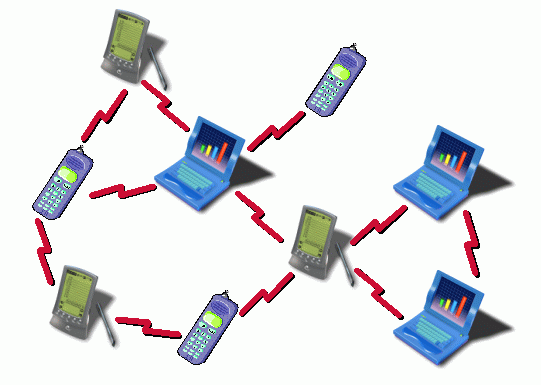 | 
Nodes can transmit packets to each other to construct an Intranet
without the assistance of any base station (Access Point).
| Nodes help each other to forward packets from hop to hop such that two nodes that can't hear each other can transmit data to each other.
Each node is typically equipped with a radio transceiver, a
small microcontroller and a battery.
| Size and cost constraints on sensor nodes result in corresponding constraints on resources such as energy, memory, computational speed and communication bandwidth. |
|---|
| TCP |
|---|
How to guarantee data delivery? |
|---|
| TCP |
|---|
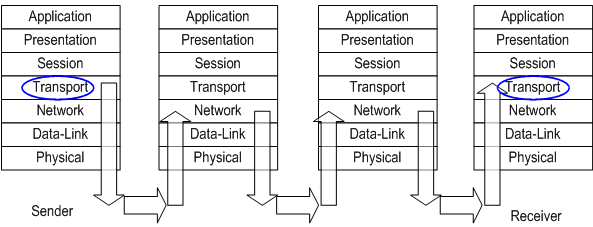
The most popular reliable transport protocol
| Located at both ends of a connection
| Reliable, in-order
| Connection-oriented
| With flow controlled
|
|  |
|---|
| Flow control & Congestion control |
|---|
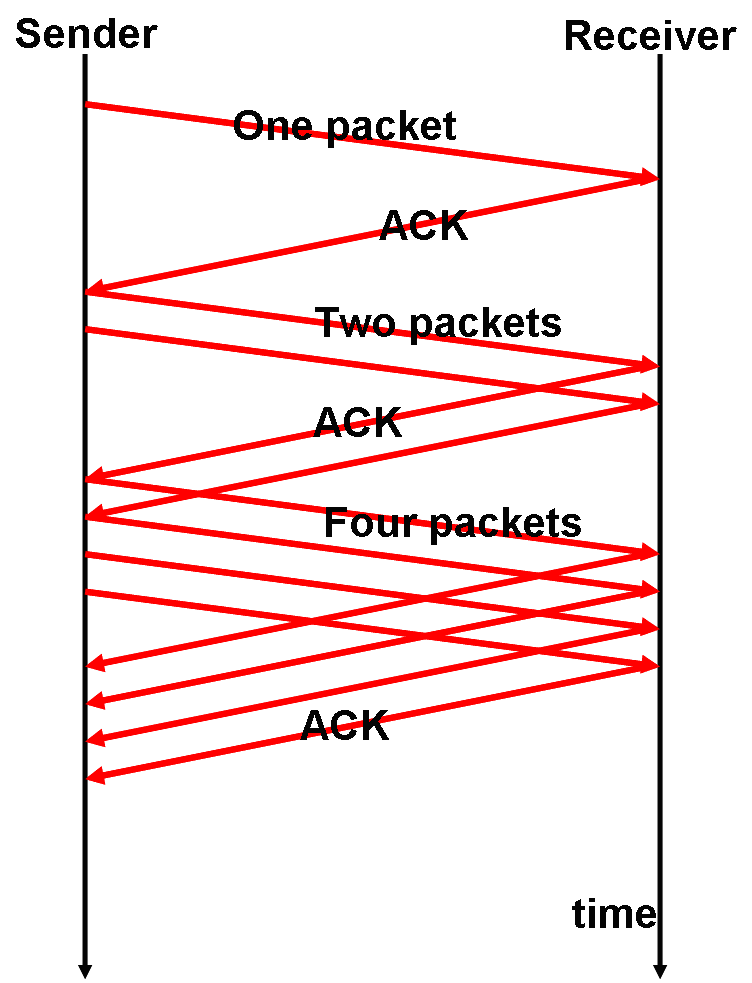
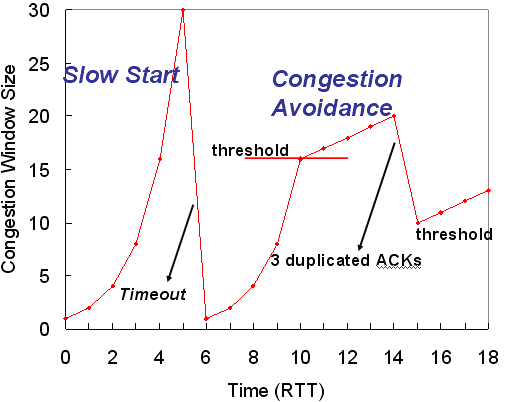
♦ Trial-and-error based flow control for controlling congestion
♦ Sliding window mechanism
adjust window size = adjust data rate
 |  |
|---|
⊕ Slow Start Problem
♦ A mechanism to resolve congestion problem
| Design Objectives of TCP |
|---|
♦ Guarantee packets delivery
♦ To maximize bandwidth utilization while minimizing network congestion
⊕ However,
MANET/Sensor Network prefers shorter delivery time to high throughput
| RFC Documents |
|---|
| RFC number | Topic
| 793
| Transmission Control Protocol
| 1323
| TCP Extensions for High Performance
| 2018
| TCP Selective Acknowledgement Options
| 2581
| TCP Congestion Control
| 2914
| Congestion Control Principles
| 3168
| The Addition of Explicit Congestion Notification (ECN) to IP
| 3390
| Increasing TCP's Initial Window
| 3782
| The NewReno Modification to TCP's Fast Recovery Algorithm
| |
|---|
| Lost Packet Retransmission |
|---|
♦ Retransmission from senderpackets may get lost again and again under high errorTake too many retransmission to reach destination -- induce long delay time | 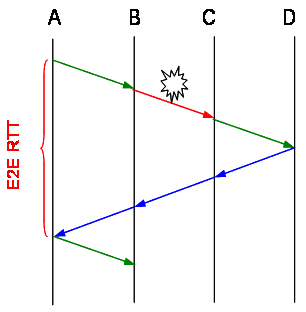 |
|---|
| Local Retransmission |
|---|
MANET/Sensor Network applications prefer fast packet delivery
♦
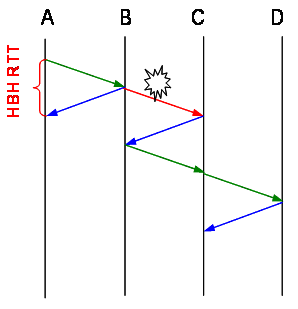
Hop-by-Hop TCP is to speed up packet delivery
Each intermediate node retransmits lost packets to assure packet
delivery
Faster than retransmission from sender
Each intermediate node retransmits lost packets to assure packet
delivery
| Faster than retransmission from sender
| |
|---|
| Retransmit from Sender | Retransmit from Local
|
| |  |
|---|
| Split TCP |
|---|
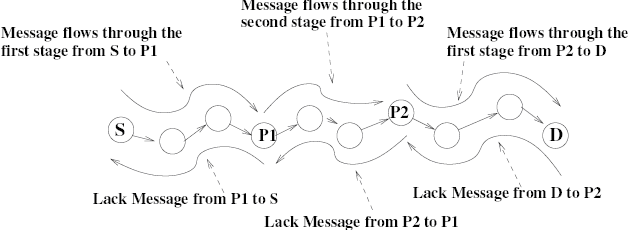
| Hop-by-Hop TCP |
|---|
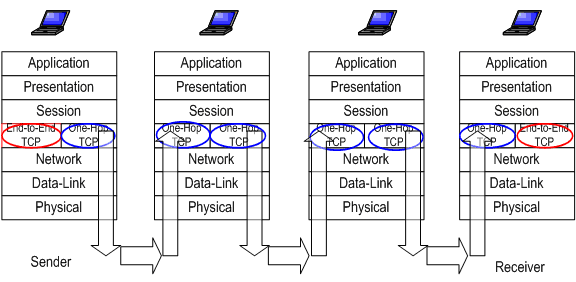
♦
Intermediate nodes (routers) do not participate in TCP execution.
Conventional TCP is executed on both ends of a connection.
On MANET, each node is a computer, which can participate in the Hop-by-Hop TCP execution.
| Related Work |
|---|
♦ Utilize info. provided by IP layer to distinguish the packet loss caused by congestion from others
ATCP (Ad Hoc TCP)
TCP Muzha
♦ Utilize intermediate node to assist congestion control
Transport layer revisited
TCP Muzha
| ATCP |
|---|
♦ A layer called ATCP is inserted between the TCP and IP layers of the source node
♦ ATCP listens to the network state by
ECN (Explicit Congestion Notification) message
Congestion!!
ICMP “Destination Unreachable” message
Network Partitioning!!
♦ Sender can be put into 3 states:
| Persist State | by ICMP message
| Congestion Control State
| by ECN message
| Retransmit State
| by packet loss without ECN flag
| |
|---|
Note - After receiving three duplicate ACKs, sender does not invoke congestion control and puts TCP in Persist State and quickly retransmit the loss packet from buffer ( Multipath routing or channel loss)
Recomputation of congestion window size after route re-establishment
| TCP Muzha |
|---|
♦ Utilize intermediate node to assist congestion control
Intermediate nodes provides status inf. to sender
Sender can adjust data rate before congestion
♦ Identify bottleneck and estimate its residual bandwidth for a better data rate adjustment.
♦ Reduce the occurrence of congestion
♦ Can distinguish the packet loss caused by congestion from random loss
| Adaptive CWL (Congestion Window Limit) |
|---|
If the congestion window size is greater than an upper bound, the TCP performance will degrade.
Find the BDP (Bandwidth Delay Product) of a path in MANET
They use this upper bound of BDP to dynamically adjust TCP’s max. window size
| The Transport Layer Revisited |
|---|
Heimlicher, Simon Baumann, Rainer May, Martin Plattner, Bernhard, “ The Transport Layer Revisited,” Communication Systems Software and Middleware, 2007. COMSWARE 2007.
♦ The framework is implemented on two sublayers
The hop-by-hop layer runs on every node and provides per-link flow control and congestion control
On this layer, data is managed in units of fragments(8 packets)
The end-to-end layer operates at the end points of the connection, provides a reliable-byte-stream interface to the application-layer, just like TCP
Data is managed as segments, which are data units comprising a few fragments(4 fragments)
♦ The end-to-end congestion control mechanism has a job similar to the congestion control algorithm of TCP: it limits the number of un-acknowledged segments on a per-connection basis.
♦ If no acknowledgement is received for a segment for a certain period, the source needs to retransmit the segment.
♦ If a packet is lost on any intermediate link, the node at the receiving side will not acknowledge the corresponding fragment and the last hop will retransmit the fragment.
| Our Approach |
|---|
⊕ Hop-by-Hop TCP
♦ Let each intermediate note assure packet delivery by buffering and local retransmission.
| Hop-by-Hop TCP |
|---|
♦ 2 Components
| End-to-End TCP | running on sender and receiver
| One-hop TCP
| running on each intermediate nodes
| |
|---|
| Design Objectives |
|---|
♦ Reduce packet delivery latency
♦ Reduce number of retransmission
♦ improve throughput
♦ maintain performance when coexist with other TCP versions
| Design Issues |
|---|
♦ Data rate control: avoid network congestion and best utilize bandwidth
♦ Fairness maintenance
♦ Handling of local and end-to-end packet loss
♦ Handling of local and end-to-end ACK loss
♦ Buffer management
| End-to-End TCP |
|---|
♦ Running at both ends of a connection to assure successful delivery of packets
♦ Reuse TCP Reno, but
Set an upper bound for CWND (congestion window size)
increase End-to-End RTO to avoid unnecessary Slow Start due to slowness of MANET
| One-Hop TCP |
|---|
♦ Used between two adjacent nodes to assure local packet delivery
♦ Functionality:
Buffer packet
Local retransmission for lost packets
| One-Hop TCP |
|---|
⊕ Data Rate
♦ CWND=1 (one packet per ACK)
No need for sliding window
⊕ Retransmission
♦ If One-Hop RTO expired w/o ACK, do the retransmission
♦ Upto Retransmission Threshold avoid useless retransmissions
Route Failure -> need to change route
Network Congestion -> need to reduce CWND (slow start)
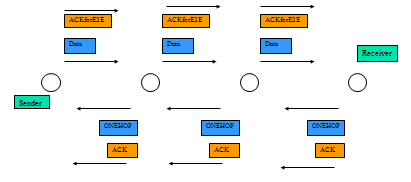
| End-to-End ACK |
|---|
| End-to-End ACK: | Same as ACK for conventional TCP
| Mechanism to improve survival rate
| Use One-Hop TCP in the reverse direction for ACK
|
|  | |
|---|---|---|---|---|---|
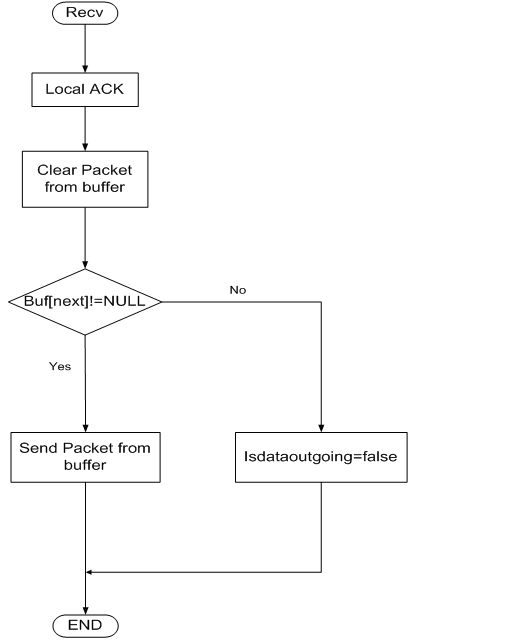
| One-Hop Flow of Receiving Local ACK |
|---|
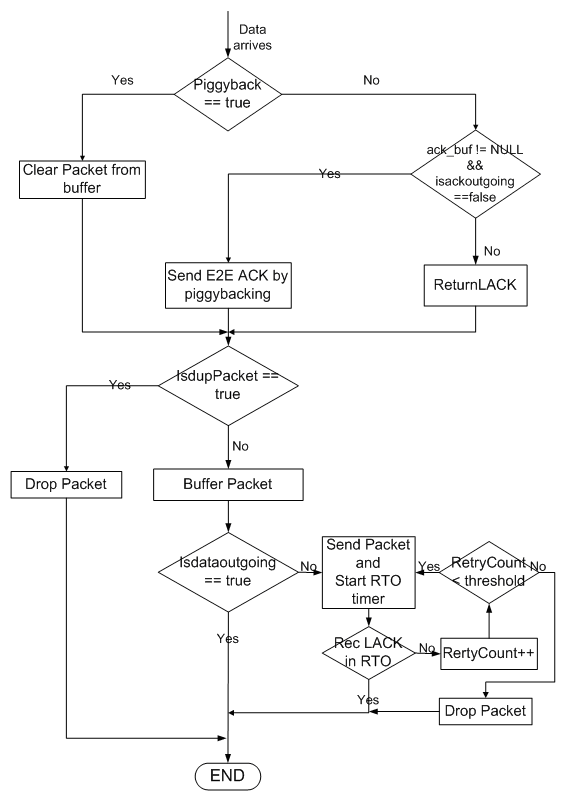
| One-Hop Flow of Receiving Data Packet |
|---|
| State Transition of One-Hop TCP |
|---|
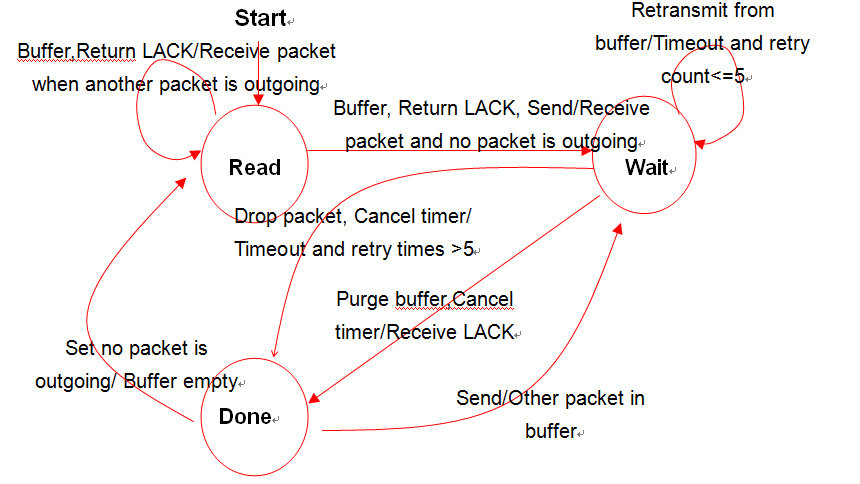
| One-Hop TCP機制 |
|---|
| Event | Status | Actions taken in the receiving node | Next state
| Receive a packet when flag
no_packet_outgoing is false
| Ready
|
Buffer the new packet; if there is any
packet to be sent in another direction,
piggyback it, if not, return LACK
| Ready
| Receive a packet and no packet is outgoing
| Ready
|
Buffer the new packet; if there is any
packet to be sent in another direction,
piggyback it, if not, return LACK, send the
packet, and start timer
| Wait
| Local Timeout and retry count < 6
| Wait
| Retransmit the Timeout packet; restart timer
| Wait
| Local Timeout and retry count > 5
| Wait
| Purge the packet that retransmits over five times from buffer; stop timer
| Done
| Receive a LACK from downstream node
| Wait
| Purge the packet from buffer; stop timer
| Done
| Other Packet in Buffer
| Done
|
Send the next packet from buffer; start timer
| Wait
| Buffer empty
| Done
|
Set flag no_packet_outgoing to true; wait the next packet
| Ready
| |
|---|
| One-Hop TCP Pseudo code |
|---|
Receive ( Packet ){
  if ( Data )
  {
     ReturtLACK ( ) ;
     if ( NewPacket_ == True )
{ BufferPacket ( ) ; }
     if ( isdataoutgoing_ == False )
       {
SendPacket ( ) ;
Isdataoutgoing == True;
}
  }
  if ( LACK )
  {
     PurgeBuffer ( ) ;
     if ( Buffer == NULL )
       { set isdataoutgoing == False ; }
     else
       { SendPacketInBuffer ( ) ; }
  }
}
|
|---|
| Overhead Reduction |
|---|
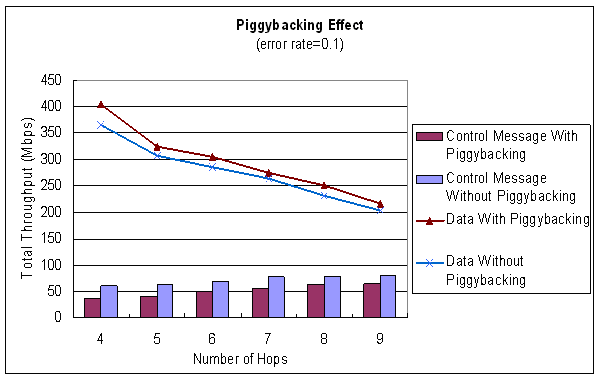
Piggyback packets in the same direction to reduce overhead
| Forward dats stream | | Backward dats stream
| |
| 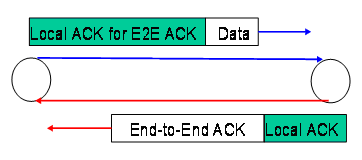 | |
|---|---|---|---|---|---|
| 802.11 MAC Layer 4-Way Handshake |
|---|
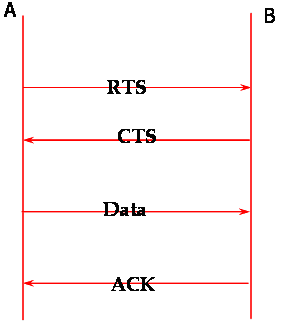
| Performance Evaluation |
|---|
♦ Evaluation by NS-2 Simulator
⊕ Evaluation Metrics
♦ Average Delay Time
♦ Average Throughput
♦ Retransmission
♦ Change of CWND
♦ Fairness Index
| Design of Experiments |
|---|
⊕ Performance Test
| Control Variables | hop count | error rate | buffer size |
|---|
⊕ Fairness Test
♦ Fairness when multiple TCP coexist
HbH and Reno Coexist
| Many HbH Coexist
| |
|---|
| Experiment 1: Topology and Parameters |
|---|

| Parameter | Range
| Packet Size
| 1000 bytes (MANET) | 50 bytes (Sensor) Buffer Size
| 50 packets (MANET) | 10 packets (Sensor) CWND Upper Bound
| 4
| Link Bandwidth
| 0.5~1 Mbps (MANET) | 5~10 Kbps (Sensor) Error Rate
| 0.0~0.2 (MANET) | 0.0-0.5 (Sensor) Number of Nodes
| 5~11
| MAC Protocol
| 802.11
| Routing Algorithm
| DSR
| |
|---|
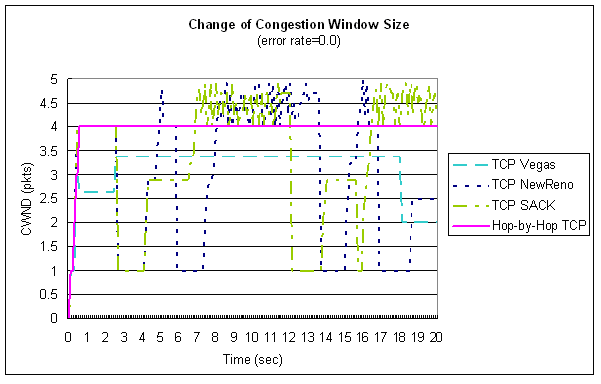
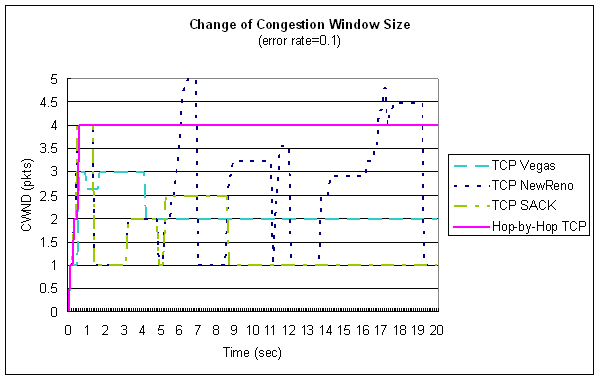
| Change of Congestion Window Size |
|---|
| ( Sensor Netowrk/error rate = 0.4) |
|
| 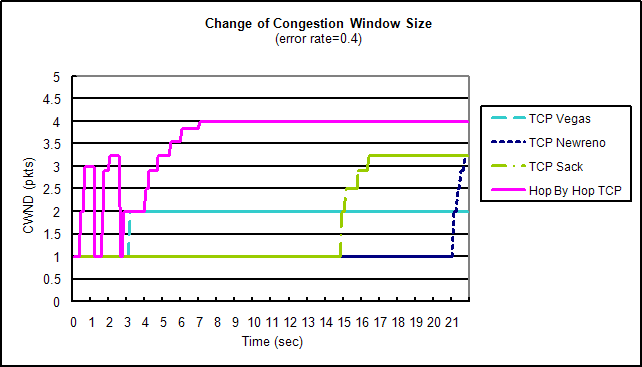 | ( MANET/error rate = 0.0)
| ( MANET/error rate = 0.1)
| |  |  |
|---|
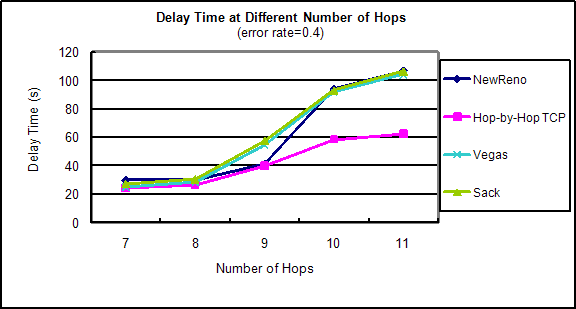
| Delay Time at Different Number of Hops |
|---|
| SensorNet/error rate = 0.4 | MANET/error rate = 0.1
|
|  | 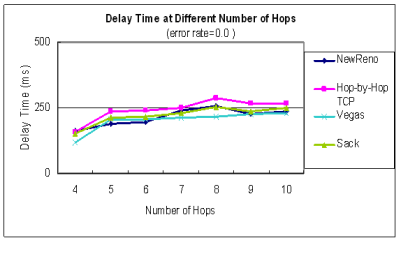 MANET/error rate = 0.1
| MANET/error rate = 0.2
| | 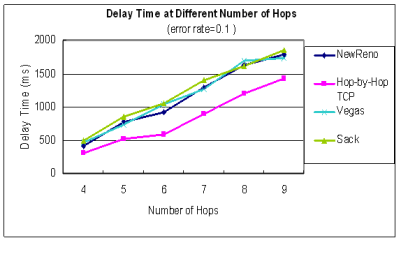 | 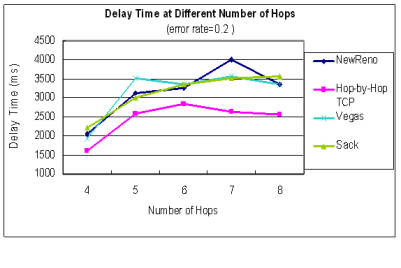
| ♦ When lost rate is high, HbH TCP can reduce delay time by 20% | |
|---|---|---|---|---|---|---|---|---|---|
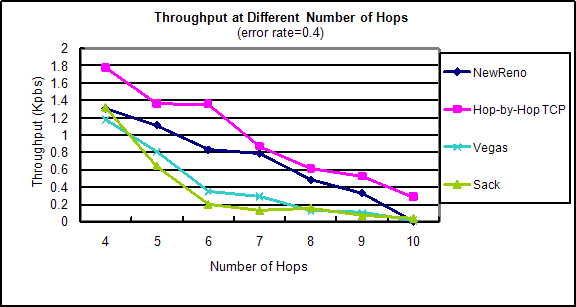
| Throughput at different number of hops |
|---|
| SensorNet/error rate = 0.4 | MANET/error rate = 0.1
|
|  | 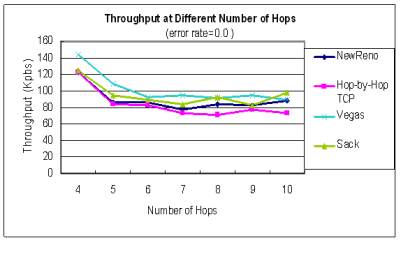 MANET/error rate = 0.1
| MANET/error rate = 0.2
| | 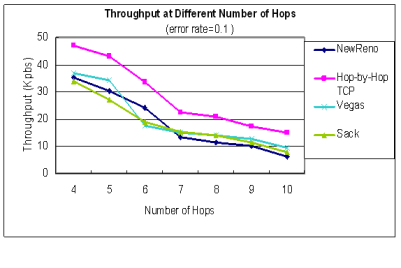 | 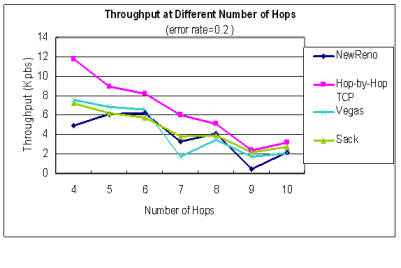
| ♦ When lost rate is high, HbH TCP can improve throughput by 25% | |
|---|---|---|---|---|---|---|---|---|---|
| Effect of Piggybacking |
|---|
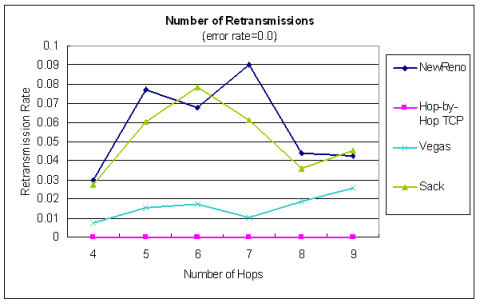
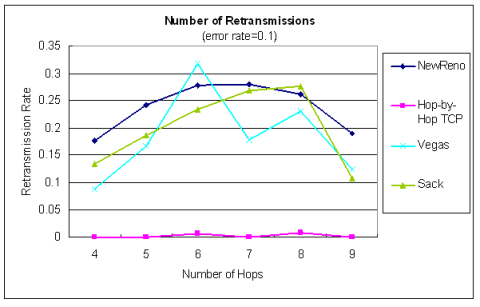
| Evaluation of Retransmission Rate |
|---|
| SensorNet/error rate = 0.4 | | | 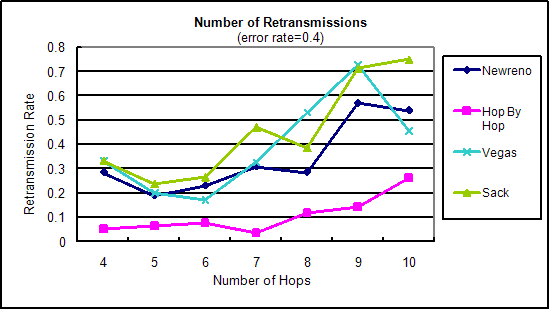 | MANET/error rate = 0.1
| MANET/error rate = 0.2
|
|  |  |
|---|
| Summary of Experiment 1 |
|---|
♦ When lost rate is high, Compared with NewReno, HbH TCP can
reduce delay time by 20%
improve throughput by 25%
♦ HbH can stablize CWND when lost rate is high
| Experiment 2 Fairness Test |
|---|
Different versions of TCP may compete for bandwidth, pessimal TCP (Vegas) may get hungry when coexist with aggressive TCP (NewReno)
| Test 2A | Fairness Test for multiple versions of TCP
| Test 2B
| Fairness Test for multiple flows of same TCP
| |
|---|
| Topology and Parameter for Fairness Test |
|---|
| Topology | Parameter | Range
|
| 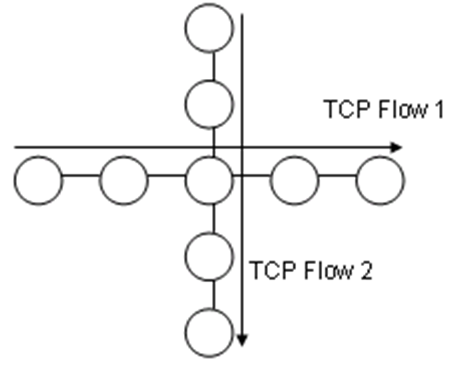 Packet Size
| 1000 bytes (MANET) | 50 bytes (Sensor) Buffer Size
| 50 packets (MANET) | 10 packets (Sensor) Link Bandwidth
| 0.5~1 Mbps (MANET) | 5~10 Kbps (Sensor) Error Rate
| 0.1 (MANET) | 0.4 (Sensor) Link Bandwidth
| 1 Mbps (MANET) | 10 Kbps (Sensor) Number of hops
| 4, 6, 8
| MAC Protocol
| 802.11
| Routing Algorithms
| DSR
| |
|---|
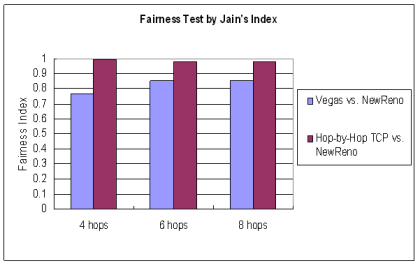
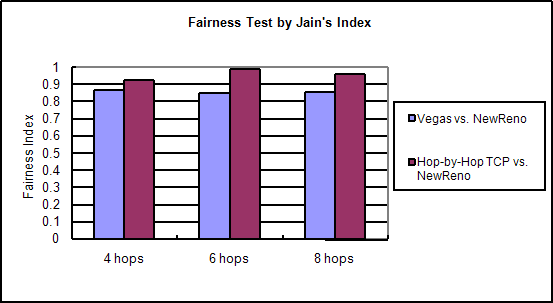
| Jain's Fairness Index |
|---|
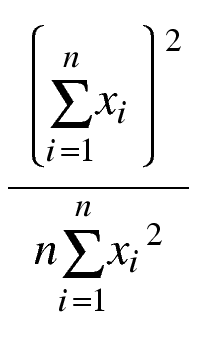
x i is the flow throughput of flow i
| equal partitioning of bandwidth achieves index of 1
| If only k of n flows receive equation bandwidth
(and others get non) index is k/n
| |
|---|
| Fairness Test 2A |
|---|
| NewReno vs. Vegas (MANET/Throughput) | NewReno vs. Hop-by-Hop TCP (MANET/Throughput)
| | 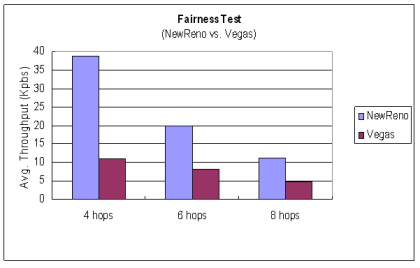 | 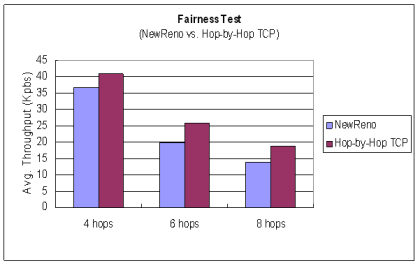 Jain's Fairness Index (MANET)
| Jain's Fairness Index (SensorNet)
|
| 
|  |
|---|
| Fairness Test 2B (MANET) |
|---|
| Protocol | Throughout Dynamics | Jain's Index Dynamics
| HbH | TCP | 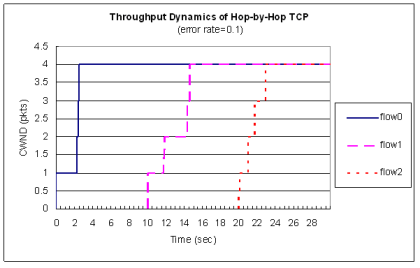 | 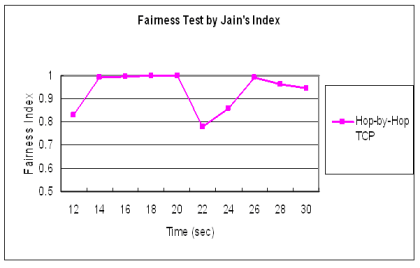 TCP | Vegas | 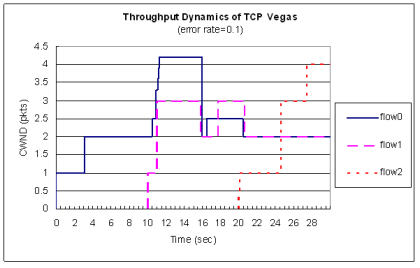 | 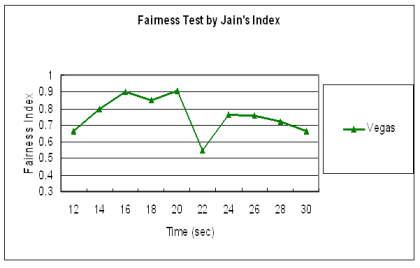 TCP | NewReno |  | 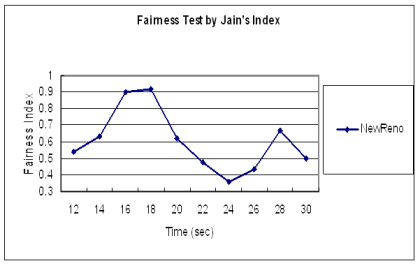 |
|---|
| Fairness Test 2B |
|---|
| MANET | Sensor Network
| | 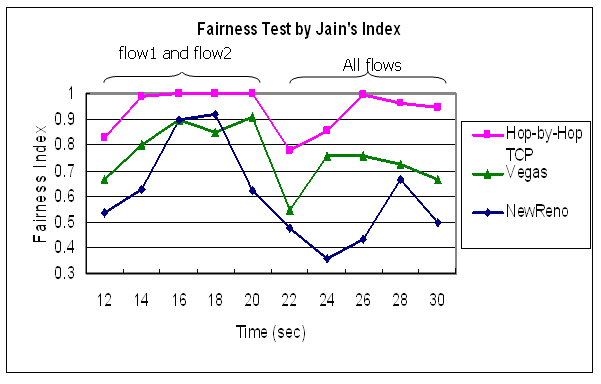 | 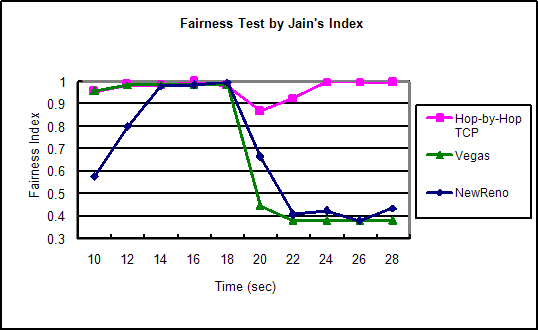 |
|---|
| Summary of Fairness Test |
|---|
♦ HbH TCP inherents Congestion Control of NewReno
Can coexist with NewReno w/o performance degradation
♦ Fair bandwidth sharing when multiple flows of HbH coexist
| Conclusion |
|---|
♦ Each intermediate node use local retransmission to guarantee packet delivery in each link
outperform NewReno in delay time and throughput
♦ When lost rate is high, Compared with NewReno, HbH TCP can
reduce delay time by 20%
improve throughput by 25%
♦ Maintain Good Fairness
| Future |
|---|